


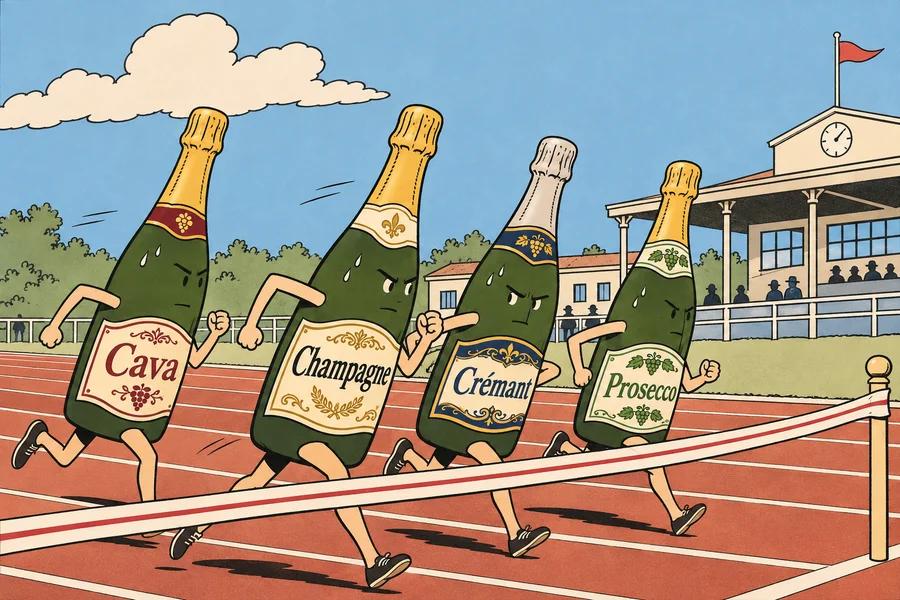
Not so long ago, choosing a bottle of traditional method sparkling wine meant choosing Champagne. Those days are firmly over. A detailed market survey across five rival categories shows that while the wider wine industry wrestles with declining consumption, fizz made outside northeast France is steadily winning converts, shelf space, and restaurant list slots. The picture, though, is far from uniform.
According to IWSR data, sparkling wine's share of global consumption rose from around 8% in 2012 to 13% in 2025, while red wine's share fell from roughly 52% to 43%. ProWein's inaugural Sparkling Report confirmed the sector's resilience, estimating the global sparkling wine market at approximately US$54.7 billion in 2025. Against that backdrop, producers in Spain, France, England, South Africa and northern Italy are competing to fill the glass that once defaulted to Champagne.
Crémant leads the charge. France's eight Crémant appellations shipped 122.9 million bottles in 2025, up 7.5% year on year, with sales growth of more than 58% over the past decade. UK imports alone hit 6.3 million bottles, a 22% rise. One standout figure: Tesco's Crémant sales reportedly surged 73% to £11.8 million in 2025. Peter Mitchell MW, wine director at Jeroboams, attributes the shift partly to rising private label Champagne prices, which have opened space for traditional method wines at a lower price point.
Cava's numbers look trickier. Volume sales fell to 190 million bottles in 2025, down about 12%, while exports dropped 18.7% to 113.9 million bottles. Yet there are signs of life higher up the quality ladder. Sales of Guarda Superior Cava rose 1.41%, with Gran Reserva up 6.09% and the top tier Paraje Calificado leaping 82.35%. The problem, as Sarah Benson MW of Alliance Wine puts it, is not quality but the perception of it: front of house teams stretched thin struggle to communicate the new classifications. Further turbulence came in April 2026 when Juvé & Camps joined the rival Corpinnat collective, becoming the largest member and nearly doubling the association's total production. Corpinnat now has 22 members. Familia Torres, meanwhile, is launching Nativa Forcada, described as the first sparkling wine made from 100% Forcada, a recovered pre-phylloxera Catalan grape.
English sparkling wine sold 6.2 million bottles in 2024, with exports up 35% on the previous year and sparkling accounting for 90% of UK wine exports. Norway, Japan and the US are the leading destinations. Ruth Simpson of Simpsons Wine Estate in Kent argues that England's climate now delivers ideal conditions for maintaining acidity while allowing sugar development. A more immediate challenge may be structural: Julien Lonneux, CEO of Vranken Pommery UK, notes that most English sparkling shares a single designation regardless of origin or production method, with the Sussex PDO a notable exception.
South Africa's Cap Classique recorded domestic sales of 4.92 million litres in 2024, up 16.3%, with exports rising 19% to 2.4 million litres. The UK is the biggest export market, and brands such as Graham Beck have solid retail distribution. Pierre de Klerk, Graham Beck's cellarmaster, points out the category is only 55 years old and still shifting from an opportunistic by-product to a deliberate, quality-focused pursuit.
In northern Italy, Franciacorta sold 18.93 million bottles in 2025, dipping 1%, while exports grew 5.3%. Trentodoc held steady at 12.2 million bottles and €180 million in turnover. Matteo Lunelli of Ferrari Trento says the challenge is making identity tangible in a crowded market, though on-trade opportunities are widening. Kent Barker, who runs Eight Stony Street in Frome, Somerset, reports that his wine bar lists multiple Franciacorta styles without difficulty: consumers, he says, will happily go "left field".
The overall picture? Champagne's prestige is intact, but it no longer holds a monopoly on it. For UK drinkers, the practical upshot is a broader, more interesting sparkling wine selection at every price point, from a £9 Crémant in a supermarket trolley to a vintage Cap Classique on a restaurant list. Whether that variety converts into sustained commercial success for each region will depend less on winemaking and more on storytelling, something many producers are still learning to do.
Source: James Lawrence, the drinks business.