


The same heatwave summer that has brought French wine production to its knees appears to be handing English sparkling wine one of its best vintages to date. It is a contrast so sharp it reads like climate fiction, except all the numbers are real. If you want to understand how rising temperatures are redrawing the global wine map, the 2026 growing season is as vivid an illustration as you will find.
France's agriculture ministry has warned that wine production could hit a 70-year low in 2026, marking the third year of reduced output. The world's second-largest wine producer after Italy is expected to produce less than 34 million hectolitres this year, down 6% from 2025 and 17% below the 2021 to 2025 average.
The ministry's statistics service, Agreste, said favourable conditions earlier in the year had supported grape development, but severe summer drought and repeated heatwaves reduced yields. The heat caused sunscald, scorching, defoliation and wilting in some vineyards, while soil drought intensified across the country.
The damage has not been evenly spread. Champagne has been particularly hard hit, with production forecast to fall 49% from 2025 and 47% below the five-year average. Burgundy-Beaujolais, the Loire Valley and Charentes have also recorded significant declines, while Bordeaux and Languedoc-Roussillon recovered somewhat from particularly weak harvests last year.
Jean-Marie Cardebat, chair of wines and spirits at the INSEEC Grande École university, put it bluntly: "We are realizing that no region in France is safe from heatwaves today." Paradoxically, the regions suffering the most are those with more temperate climates, namely the Loire Valley and Champagne.
Around 4% of all of France's vines will be pulled this year as part of a government programme paying growers €4,000 per hectare for permanently removing vines. The French government has also announced more than €1 billion in emergency assistance for farmers and winegrowers. France's Environment Minister Monique Barbut estimated the wider economic damage from the heatwaves at between €10 billion and €15 billion.
Meanwhile, across the Channel
While France counted its losses, Nyetimber, based in West Sussex, began the first stage of its harvest on 14 September, making it the earliest picking ever. The harvest was initially scheduled to begin the following week but was pushed forward because certain vines had already matured.
The harvest kicked off several weeks earlier than the average start date, thanks to the consecutive heatwaves that have defined summer 2026. Frosts in May had damaged 30% of Nyetimber's vineyards across West Sussex, Hampshire and Kent, but soaring temperatures over the summer helped vines to recover, meaning that despite yield being compromised, quality is still expected to be high.
Nyetimber expects the yield to reach 2,500 tonnes of grapes, resulting in approximately 1.5 million bottles of sparkling wine from the 2026 vintage. Given the high quality anticipated, it is likely that 2026 will be another vintage year. Nyetimber produces both multi-vintage and vintage-dated wines, and the latter are only made from grapes from one vintage, limited to years of distinctive quality.
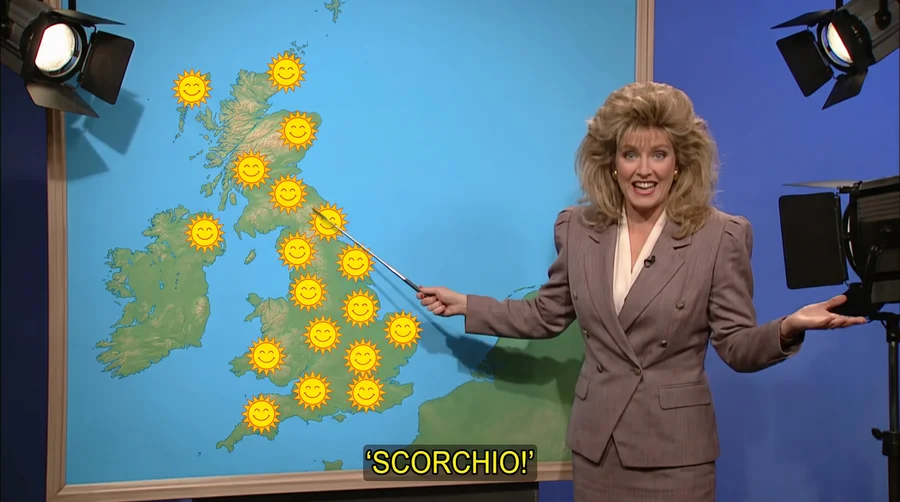
The context behind these early harvests is striking. An average mean temperature of 16.5°C puts summer 2026 as provisionally the warmest on record for the UK, as well as the warmest season in a series going back to 1884. Looking solely at average daytime maximum temperatures through the season, 2026 is also the warmest on record, surpassing the record set in 1976. That means the UK has now broken its own summer heat record in consecutive years. Summer 2025 was confirmed as the warmest on record for the UK only last September.
Met Office scientists say these records are breaking with increasing frequency, reflecting the influence of human-induced climate change on UK temperatures.
A shifting geography of wine
What France and England are experiencing in 2026 looks less like an anomaly and more like an acceleration of trends researchers have been tracking for years. Average growing-season temperatures in southern England have risen two degrees since the 1970s, and over the past 20 years the warming climate has indisputably boosted the English wine industry.
The UK's winemaking industry has established itself as one of the fastest-growing agricultural sectors in the country. According to IBISWorld, the sector's total revenue has grown at a compound annual rate of 6.5% over the past five years, reaching an estimated £477.6 million in 2026, with WineGB data showing 1,158 vineyards and 280 wineries across the UK in 2025.
Knight Frank reports that the area of planted vineyards has quadrupled since the turn of the century. Forecasts suggest continued growth, with annual production projected to reach 25 to 29 million bottles by 2032 and retail value potentially hitting £1 billion by 2040.
Research from the University of East Anglia has mapped what this could mean in practice. Dr Alistair Nesbitt found that Champagne-region grape growing temperatures from 1999 to 2018 are projected to occur across an expanding area of England during 2021 to 2040, and that in certain years a few areas of the UK may see growing season climates similar to those that contributed to the very best recent vintages of Champagne.
The investments in English vineyards by Taittinger and Pommery have been followed by the arrival of Jackson Family Wines and Domaine Duroché, signalling that major producers from established regions are treating southern England as a serious, long-term proposition rather than a novelty venture.
None of this means English wine is about to replace French wine on your shelf. France produces nearly 300 million bottles of champagne annually, while the UK still only reaches about 8.3 million bottles of sparkling wine. England's advantages remain tightly bound up with unpredictable weather, limited scale, and higher production costs. Researchers warn that the rapidly changing UK climate requires the industry to remain agile and not lock into production which cannot adapt to changing growing conditions.
But the direction of travel is hard to argue with. When France is pulling up 4% of its vines and England is breaking harvest records in the same September, the old certainties of the wine world look increasingly unreliable. For UK drinkers curious about what is happening in their own backyard, 2026 is shaping up as the year that made the argument impossible to dismiss.
Source: French production figures reported by Sybille de La Hamaide, Reuters, 7 September 2026; additional reporting by CNBC and France 24. Nyetimber harvest reported by Anahita Hossein-Pour, Evening Standard, 14 September 2026, and Drinks Retailing News. UK temperature data from the Met Office. English wine growth data from WineGB, IBISWorld, and the University of East Anglia.