The Vino Smoothie
You've got a young, tannic red that tastes like it's trying to sandpaper your tongue. You haven't got five years to wait. You haven't even got five hours. What you have got is a blender, a reckless spirit, and nothing left to lose.
By the end of this piece, you'll understand hyper-decanting: what it does, what it doesn't do, and whether you should actually try it or simply enjoy the chaos of the idea.
What you'll learn
What hyper-decanting actually is and why it exists
Whether blending wine genuinely softens tannins
What you'll sacrifice in the process
The principle
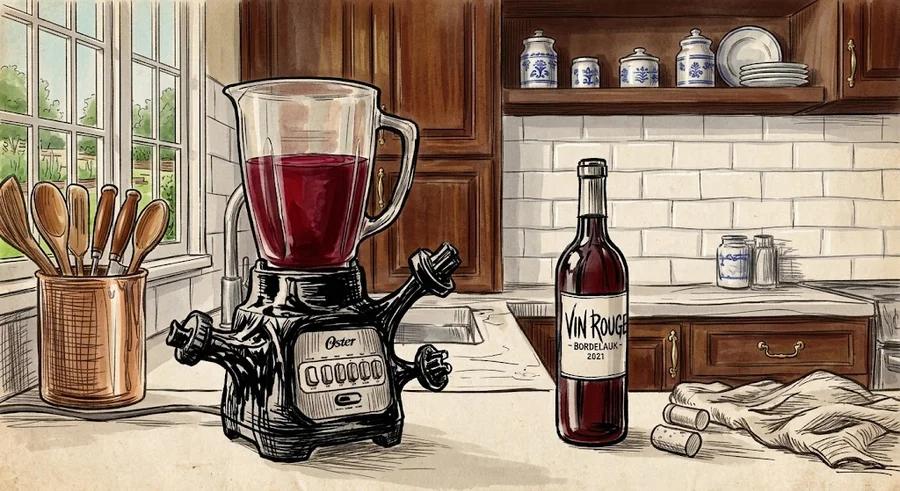
Standard decanting exposes wine to oxygen over 30 minutes or so, gently coaxing out aromas and softening harsh edges. Hyper-decanting asks: what if we did all that in a few seconds, violently? Pop the wine in a blender, whizz it, and you'll be staring at something that looks more like a berry smoothie than a Bordeaux. The massive surface-area exposure to air does, genuinely, knock back aggressive tannins in young reds.
The gentler alternative
For those who find the blender approach a touch barbaric, a milk frother offers a middle path. Less mess, less drama, same basic idea.
30 seconds in a blender does not equal five years of bottle ageing; the science behind bottle ageing is annoyingly more complicated than just oxygen.
What you lose
Blending will change the wine, certainly, and may well soften tannins in a very aggressive young red. However, you will lose some fruit character and any more delicate aromatics. A blender is not a time machine. Bottle ageing involves slow chemical reactions, the gradual evolution of tannin chains, esters forming, acids softening. Oxygen is only one part of that story. So manage your expectations accordingly.
What to watch out for
Don't try this with delicate, aged, or expensive wine. You'll destroy precisely what you paid for.
Over-blending turns wine into flat, frothy disappointment. A few seconds is plenty.
It won't rescue a faulty wine. Corked is corked, blender or no blender.
Putting it into practice
Grab a cheap, young, tannic red, something under £8 that makes your gums ache. Pour half into a blender for three seconds, leave the other half untouched, and taste them side by side. You'll notice real differences, and you'll learn something about what oxygen does to wine. For more on taming tannins the conventional way, have a look at our guide to decanting.
FAQ
Is hyper-decanting the same as normal decanting?
Same principle, wildly different execution. Both expose wine to oxygen, but hyper-decanting does it in seconds rather than minutes. The results are faster but cruder.
Do I need a special blender?
No. Any kitchen blender works. A milk frother is gentler and less messy if you'd rather not explain purple splatter marks on your ceiling.
Does hyper-decanting work on white wine?
There's little point. The main benefit is softening tannins, which whites have very little of. You'd mostly just lose aromatics and end up with frothy Pinot Grigio.
What should I learn after this?
Proper decanting. Understanding which wines benefit from air, and how long they need, is far more useful than owning a blender with wine stains.