


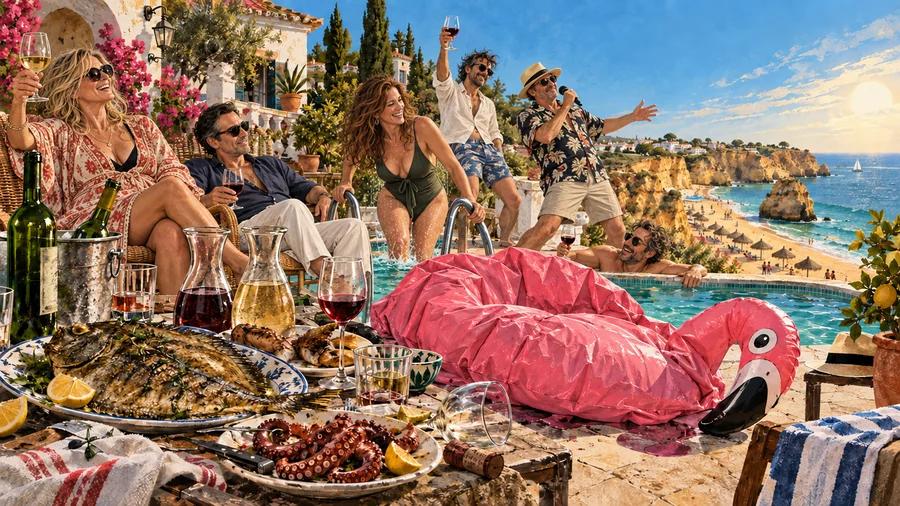

There had been a plan. There is always a plan before several old friends arrive at a villa in Portugal.
This one involved an ambition to examine at least some of the wines of the Algarve: indigenous grapes, reviving vineyards, the influence of the Atlantic and the compelling buzz for Negra Mole. Bottles would be photographed. Labels would be recorded. Tasting notes would contain words like texture and salinity. I would return home with some knowledge of a region whose wine deserves more attention.
Instead, we drank supermarket Vinho Verde beside the pool and killed a flamingo.
Day one: Alvarinho and the death of Flo
Alvarinho is not an Algarve wine. It comes from the greener, wetter north-west of Portugal and therefore had no legitimate place in my investigation. It was, however, cold, Portuguese, very moreish and available immediately thanks to our generous hosts. These are serious qualities when the sun is out and there is a pool ten feet away.
Cold white wine under blue sky, with tunes, books, chat, abundant nibbles and illicit cigarettes, creates a drinkability problem. It refreshes, disappears and demands the discipline that another bottle be placed in the refrigerator long before the current one is finished.
This is not necessarily inferior consumption. Wine does not always need to reveal the geology beneath a particular south-facing slope. Sometimes its proper purpose is to make the afternoon wider.
The September late-summer heat had lost the intensity of August, but the Sun was still in charge. Doors stayed open. Meals drifted outside. The pool provided the focus of events and, before long, its first casualty.
Flo was an inflatable flamingo. She was large, pink and the subject of many of our hosts’ family photos. Her death was accidental but, due to tomfoolery, it was premature. There is a peculiar guilt in puncturing an inanimate animal. She did not suffer and had no dependants, yet her detached wing and collapsing neck created instant regret. Flo spent the remainder of the weekend folded over herself at the edge of the pool, a bright vinyl monument to my inability to look after nice things.
We escaped the scene by walking to Praia do Trafal, then continued along the sand towards Vale do Lobo. It is difficult to maintain solemnity on that stretch of coast. The light was golden, the Atlantic waves hypnotic enough for us to reflect on our loss, and the beach bar intuitively understood that rosé should arrive cold and without delay at any flamingo wake.
The identity of ours has not survived. This is the truth about holiday wine: the pleasure can remain after the label has completely disappeared. Readers wishing to conduct themselves more professionally should ask for an Algarve rosé made from Negra Mole. ARVAD Negra Mole Rosé would provide a pale, local and genuinely distinctive alternative to anonymous Provence pink. Morgado do Quintão Palhete Rosé, made from Crato Branco and Negra Mole, would be even more interesting: an old Portuguese meeting of white and red grapes, positioned somewhere between rosé, pale red and agricultural common sense.
We drank several glasses of whatever they were opening and walked back feeling refreshed.
Dinner was at Marufo 1, or Chicken Shack as our hosts affectionately refer to it. A basic joint where the principal business is chicken rather than theatre. It comes hot from the grill, skin blistered, smoke in its joints, accompanied by chips and the sort of tomato-and-onion salad that exists to receive meat juices. Cutlery rapidly becomes ornamental. Everyone develops shining fingers.
The final straggler had arrived by then, giving the evening a fresh injection of high spirits at precisely the point when restraint might have been useful. There was Vinho Verde, inexpensive red wine and the pleasure of a restaurant confident enough not to overexplain itself. Service throughout the weekend had this same admirable consistency: friendly, swift and observant, without the performative intimacy that tourist restaurants sometimes impose on their customers.
A simple house red is entirely at home with grilled chicken. It need not be memorable when tasted alone. It needs fruit, enough acidity to deal with salt, fat and spice, and the humility to arrive by the unlabelled half litre.
The evening should probably have ended there.
Back at the villa, more bottles were opened. The exact number is unavailable because the principal witnesses are unreliable and some of the evidence was removed before breakfast. There was swimming in underwear, followed at approximately three in the morning by a committed rendition of The Special AKA’s “Free Nelson Mandela”.
Without the necessary constraints in place, 3am passed to the sound of another cork.
Day two: consequences
Saturday morning came and went. Shutters down.
The beautiful weather continued, which felt personally insensitive. Upon rising, sunlight reached every part of the villa and revealed glasses, abandoned clothes and the remains of decisions that had seemed easily defensible several hours earlier. Flo continued to be dead.
Weekend travel itineraries tend to omit the hours lost to self-inflicted incapacity. Yet a hangover is also an authentic form of tourism. It slows the visitor sufficiently to notice ceiling fans, tiled floors, the value of shade and the astonishing distance between a bed and a glass of water.
Most of Saturday was significantly impeded. There would be no visit to Wine Emotion, no fulfilling conversations with their expert team and no comparative tasting of native grapes. The academic component of my trip had been cancelled by the enthusiasm of its principal researcher.
Revival eventually came later that evening at Restaurante A Cabana in Quarteira. Sea bass arrived beautifully cooked: crisp skin, soft white flesh and none of the unnecessary architecture sometimes imposed upon good fish. I drank no wine. This wasn’t an act of temperance just a temporary failure of imagination.
Others in the group tucked into the house speciality, succulent black pig, accompanied by carafes of the house red.
Pudding restored my courage. It was an intriguingly fragrant tonka bean and almond tart, with a flavour that moved between chocolate, almond, liquorice allsorts and something more illicit. A couple of digestif ports followed. Port does not exactly cure a hangover, but its medicinal properties can help persuade your day to develop a second act.
The staff treated us with the same composed hospitality found everywhere else: good humour, no rush and no visible concern that some members of the table were operating on reduced power. Portugal is very good at leaving people alone without making them feel neglected.
Day three: appetite returns
On Sunday, the desire for wine returned.
There was Vinho Verde by the pool at breakfast. The best poolside breakfast wines arrive pale, sharply cold and carrying perhaps a faint prickle of carbon dioxide. There is citrus, green apple, a modest amount of alcohol and nothing that demands you stop talking while drinking it. A bottle empties without ceremony. Another appears. It’s not yet 10am.
These wines are often exactly right in Portugal and strangely diminished when brought home. The bottle that tasted like cut limes and liberation beside the pool can taste thin and slightly fizzy beneath a British kitchen light. This is not fraud. Place is an ingredient, and some ingredients cannot pass through airport security.
Lunch at Temperus, on Praia do Trafal, supplied the meal the weekend had been moving towards. Grilled octopus came first: charred at the edges, tender inside, carrying olive oil, garlic and the mineral taste of food eaten within sight of the sea. Then came an exceptional turbot, its flesh rich, gelatinous around the bones and requiring little more than heat, salt and restraint. Others enjoyed a large bream to share and a generous cataplana with enourmous mussels.
Several bottles of an Encruzado blend from the Dão accompanied this feast. The name, disgracefully, went unrecorded. Rather than invent this retrospectively, here is what you should be ordered in the same circumstances.
With the octopus, look for Morgado do Quintão Crato Branco. Crato Branco is the Algarve name for Síria, a traditional white grape capable of ripe citrus and stone-fruit flavours with a broader, slightly waxy texture. It has enough substance for charred octopus without turning lunch into work.
With the turbot, ask for Cabrita Negra Mole Branco or another white wine made from Negra Mole. Producing white wine from the Algarve’s emblematic red grape is more than a technical curiosity: it demonstrates why Negra Mole is making itself known. The variety can become white, rosé, palhete or pale red, adapting to both heat and the modern appetite for lighter wines. If none is available, choose an Algarve Arinto, whose sharper acidity will cut cleanly through the richness of the fish.
After lunch we walked along the beach. The afternoon softened. Nobody made any proposals involving vineyards or educational tastings.
Instead, we encountered the ‘Lagertini': Sagres beer with Martini Rosso. This was new to me. It combines the cold, uncomplicated refreshment of lager with the bittersweet herbs and caramel of red vermouth. On paper it resembles something devised during a teenage houseparty. Under the late-afternoon Algarve sun, it made considerably more sense. Many things do.
The airport beckoned.
What to drink around Almancil
Anyone attempting a more disciplined version of this trip should look for six things:
Crato Branco, particularly Morgado do Quintão, for a traditional Algarve white.
A white Negra Mole, from Cabrita or Morgado do Quintão.
Morgado do Quintão Palhete Rosé, combining Crato Branco and Negra Mole.
ARVAD Negra Mole Rosé, ideally at the beach.
Morgado do Quintão Clarete, served cool rather than at warm-room temperature.
Cabrita or Villa Alvor Negra Mole red, lightly chilled, with grilled pork or chicken.
With porco preto, ask for a local red based on Negra Mole or Castelão and request it slightly cool. The pork’s sweet fat and char need freshness more than oak or alcoholic weight. If the restaurant offers only its house red by the jug, order that without anxiety.
The local carafe deserves defending. Tap wine may be young, simple and anonymous. It may arrive colder than expert opinion permits. It may have no known back story involving ancestral parcels, hand-numbered bottles or a winemaker with international profile. It can still be exactly what is wanted with grilled chicken, black pork or a plate of fish.
The sensible traveller enjoys it there and leaves it there. Do not spend the final morning trying to source six bottles for the flight home. The wine’s natural habitat is a shaded table, a paper cloth, a plate of something salty and an afternoon with no pressing responsibilities. Removed from those conditions, it may become an expensive version of something that Aldi can surpass for less than a fiver.
Almancil gave us excellent fish, greasy fingers, late-summer sunlight and hospitality far better than our behaviour deserved. It also offered a useful correction to the notion that appreciating wine requires dilligent attention to labels.
Sometimes the label matters. Negra Mole and Crato Branco are worth seeking because they explain something particular about the Algarve.
Sometimes the bottle matters less than the table, and sometimes the most persistent memory is not a tasting note at all, but a dead pink flamingo beside a swimming pool and several grown men singing for the freedom of Nelson Mandela at three in the morning.