


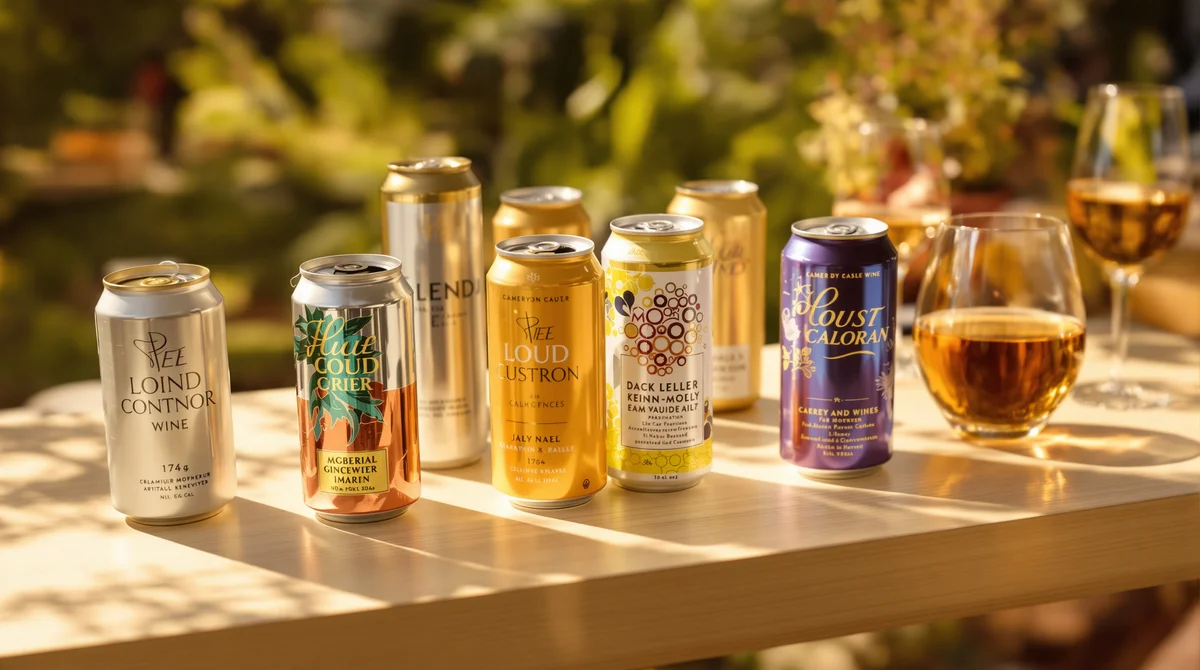
No grape dreams of aluminium. Some end up surprisingly happy there.
The train is motionless outside Clapham Junction. The vestibule is full, the air is warm and somebody else's rucksack has entered into a more intimate relationship with your ribs than either of you intended. The toilet is one carriage away, which in present conditions might as well be Normandy. But this is not your first rodeo. These conditions are not unexpected and you have come prepared. From your bag, you extract and open a chilled can of Sauvignon Blanc as your fellow commuters look on with unconcealed jealousy, unaware that you also have a cheeky rosé in reserve should the journey develop into an endurance event.
No grape spends its formative weeks on the vine nurturing dreams of becoming wine in a can. It imagines a bottle, perhaps a cork, perhaps a linen-covered table and a person who knows what a decanter is for. Marcel Lucont understands its disappointment. In his poem Wine in a Can, he describes the grape's journey:
Is society really so far down the pan
That we are actually fine with some wine in a can?
As the vineyard grape completes its noble lifespan
To be lovingly picked by a sure steady hand
Then fucked into a tin
To be wine in a can.
That is the case for the prosecution. The defence has trains, festivals, picnics, coolboxes, beaches, hotel minibars and the entirely reasonable desire for one or two glasses without opening a bottle. If you are going to enter this compromised but extremely convenient world, these are the cans worth pulling open.
Are supermarket canned wines actually any good?
The best supermarket canned wines are now proper wines chosen for the format, not anonymous plonk wearing festival clothes.
In August 2026, The Independent recommended supermarket cans made from Grüner Veltliner, Loire Gamay, Puglian Primitivo, Sicilian Catarratto and English sparkling wine. The Guardian argued in July that the format suits fresh, youthful wines, while Jane MacQuitty's June tasting for The Times also found that quality had improved. Rosé and fizz were less consistent than still whites and reds.
The important distinction is between wine that happens to be canned and wine whose producer has made a convincing decision to use a can. The latter tends to name the grape, the region and the winemaker. It also tastes like wine rather than a lifestyle campaign that has had grapes explained to it.
Which are the best canned wines in UK supermarkets?
The best current UK supermarket cans include Canned Wine Co Grüner Veltliner, Vinca Organic White, Canned Wine Co Gamay, Terre di Faiano Primitivo, The Uncommon English White and M&S Bramble Hill Sparkling Brut.
Prices and availability below were checked online on 17 August 2026. Local stock, promotions and alcohol pricing can vary.
| Wine | Supermarket | Price and size | ABV | Origin | Character |
|---|---|---|---|---|---|
| Canned Wine Co Grüner Veltliner | Waitrose | £5.75, 250ml | 11.5% | Lower Austria | Peppery, fresh, premium |
| Vinca Organic White | Ocado | £3, 187ml | 12.5% | Sicily | Clean, portable value |
| Canned Wine Co Gamay | Ocado | £5.85, 250ml | 12.5% | Touraine, Loire | Light, chillable red |
| Terre di Faiano Primitivo | Waitrose | £4, 250ml | 13.5% | Puglia | Rich, ripe red |
| The Uncommon English White | Ocado | £6.15, 250ml | 11% | Kent | Aromatic, distinctly smart |
| M&S Bramble Hill Sparkling Brut | M&S and Ocado | £5, 200ml | 11% | Kent | Brisk English fizz |
| Mirabeau Prêt-à-Porter Rosé | Waitrose, Sainsbury's | about £3.75 to £4, 250ml | 13% | southern France | Polished dry rosé |
| Villa Maria Sauvignon Blanc | Tesco, Morrisons | £3.65 to £3.75, 200ml | 12.5% | Marlborough | Familiar, dependable |
| Vinca Organic Rosé | Tesco | £3, 187ml | 11% | Sicily | Sensible single serve |
| La Vieille Ferme Rosé | Tesco | £3, 200ml | 12.5% | southern Rhône and Provence | Known producer, easy drinking |
Canned Wine Co Grüner Veltliner, Waitrose
Green apple, citrus and Grüner's peppery lift make this the clearest answer to anyone who assumes a can cannot contain interesting wine. The Independent called it a step up in quality. Enough character to survive the absence of a glass, but not enough power to make Waterloo look like Ibiza.
Best for: the best all round white.
Vinca Organic White, Ocado
Vinca is a can first brand rather than a bottled wine wearing temporary aluminium. Its Catarratto is citrusy, lightly tropical and fresh enough for emergency station sushi. At roughly a quarter bottle, 187ml is genuinely single serve. Ocado currently gives 12.5% ABV, despite a lower figure in one review, so check the can.
Best for: value, portability and a credible white under £4.
Canned Wine Co Bright & Juicy Gamay, Ocado
Strawberry, cherry and spice from old vine Touraine Gamay become even more useful with a short chill. Both Luke Flunder and Jane MacQuitty picked it out in 2026. At £17.55 per 750ml equivalent, this is premium wine in a portable format, not cheap wine in expensive clothes.
Best for: barbecues, charcuterie and people who refuse to spend summer drinking rosé by administrative decree.
Terre di Faiano Primitivo, Waitrose
Dark cherry, vanilla and spice give this enough body for a burger or cold roast beef. It feels complete rather than like compensation for a forgotten corkscrew. At 13.5%, the can contains about 3.4 UK units. Its dimensions may suggest fizzy pop, its arithmetic does not.
Best for: the fullest red and the strongest value to flavour ratio.
The Uncommon English White, Ocado
The Uncommon proves canned wine can look modern without becoming infantile. Clarence is crisp and aromatic, with gooseberry, elderflower and peach, and The Guardian called it genuinely brilliant. Its £18.45 bottle equivalent buys English grapes, a distinctive blend and a brand built around the can.
Best for: the classiest can and the best British still wine.
M&S Bramble Hill Sparkling Brut, M&S and Ocado
Made for M&S by Silverhand Estate, Bramble Hill is floral and citrusy with a brisk gooseberry note. Luke Flunder called it the best value route into English fizz, reasonable when a bottle can require a meeting with the household budget committee. The 200ml can contains 2.2 units.
Best for: affordable English fizz.
Mirabeau Prêt-à-Porter is the polished rosé option, from an established producer rather than a packaging start up with a mood board. Villa Maria brings familiar Marlborough Sauvignon Blanc certainty. Vinca Organic Rosé is the better commuter calculation at 187ml and 11%, while La Vieille Ferme offers a known southern French producer in portable form. All four are credible choices, the six above make the stronger case for what the can can add.
Which supermarket has the best canned wine range?
Waitrose has the broadest serious canned wine range, while Ocado has the strongest collection of specialist and English cans.
Waitrose spans Austrian Grüner, Spanish Garnacha, Puglian Primitivo, Mendoza Malbec, Marlborough Sauvignon Blanc and southern French rosé. Stock moves, but it is the supermarket most likely to offer a choice based on grape and origin rather than merely colour.
Ocado is particularly strong for Vinca, Canned Wine Co and The Uncommon, as well as M&S Bramble Hill. Tesco has improved sharply with Vinca, Villa Maria and La Vieille Ferme alongside the cheaper 19 Crimes range. Morrisons offers Villa Maria, 19 Crimes and the lightly sparkling Most Wanted Pinot Grigio cans. Sainsbury's lists Mirabeau, Most Wanted Sauvignon Blanc and the inexpensive PinotPinot fizz range.
Aldi, Lidl, Asda and Co-op did not produce a sufficiently convincing, nationally listed single serve wine can for this shortlist when checked. Their canned cocktail and spritz selections are much larger, but a wine based drink with added flavouring or carbonation is not automatically the same thing as a straightforward can of wine.
How much alcohol is in a can of wine?
A typical supermarket wine can contains about 2 to 3.5 UK units, depending on its size and ABV.
- 187ml at 10.5%: about 2 units
- 187ml at 11%: about 2.1 units
- 200ml at 12.5%: 2.5 units
- 250ml at 11%: 2.75 units
- 250ml at 13%: 3.25 units
- 250ml at 14%: 3.5 units
This matters. The can looks like a soft drink and may be consumed from the same opening, but Canned Wine Co Garnacha at 14% is not a casual thirst quencher. Conversely, an 11% Vinca rosé in a 187ml can offers substantially less alcohol than the strongest 250ml reds.
For the weary commuter stationed in the vestibule of a crowded train out of London, the attraction is concentration rather than heroic drinking. Three 330ml cans of beer mean almost a litre of liquid and an Olympic campaign towards the next carriage. One small can of wine provides a modest anaesthetic haze in 187ml or 200ml. It will not repair the signalling failure, but neither will it create quite the same immediate administrative burden for your bladder.
Drink some water too. British rail travel has enough jeopardy already.
Is canned wine cheap?
Canned wine is convenient, but it is rarely cheap when compared by volume with a 750ml bottle.
Vinca at £3 for 187ml is equivalent to roughly £12 a bottle. Canned Wine Co Grüner Veltliner at £5.75 for 250ml becomes £17.25. The Uncommon English White works out at £18.45. The lower shelf starts at about £9 per bottle equivalent, but the best cans generally occupy the £12 to £18.50 bracket.
The value lies elsewhere. You carry less weight, chill it quickly, need no glass or corkscrew and open only what you intend to drink. A £6 can is expensive wine by the litre, but cheaper than opening a £15 bottle for one glass and discovering it behind the milk five days later, diminished and reproachful.
Does wine taste metallic from a can?
Properly canned wine should not taste metallic because the liquid sits inside a protective lining rather than against bare aluminium.
Cans also exclude light and oxygen effectively, which suits fresh wines intended to be drunk young. They are not designed for long bottle ageing, so check the best before guidance and do not establish a ceremonial canned wine cellar under the stairs.
Drink straight from the can when circumstances demand it. If a glass is available, use it. Aroma is part of flavour, and the narrow opening was engineered for portability rather than the full expression of Bacchus.
Is canned wine better for the environment?
Wine cans usually have a transport advantage over glass bottles because aluminium packaging is much lighter and easier to pack.
The overall calculation still depends on recycled content, transport, local recycling and how the aluminium was produced. The honest claim is not that every can is environmentally immaculate. It is that moving a small, lightweight container generally makes more sense than moving a heavy single use glass bottle when the wine is intended for immediate drinking.
Recycle it. Otherwise the sustainability argument becomes branding printed on litter.
What is the Press For Wine verdict?
Canned wine has escaped the bargain bin, although it has not escaped variable quality or occasionally exhausting branding.
For the best white, buy Canned Wine Co Grüner Veltliner. For value, choose Vinca Organic White. For red, Terre di Faiano Primitivo offers the most flavour for the money, while Canned Wine Co Gamay is the more elegant choice. The Uncommon makes the strongest case for stylish English wine, and Vinca Organic Rosé is the most sensible commuter can.
Marcel Lucont remains spiritually correct. A grape would almost certainly prefer a bottle. But grapes do not attend festivals, pack coolboxes or stand outside Woking while somebody investigates a points failure. We do. Sometimes civilisation is not what surrounds the wine. It is remembering to bring one.
What do people ask about canned wine?
How many glasses are in a can of wine?
A 187ml can contains about one and a half 125ml glasses, a 200ml can contains 1.6 glasses and a 250ml can contains two glasses. A 250ml can is one third of a standard 750ml bottle.
Can canned wine be drunk straight from the can?
Canned wine can be drunk directly from the can, which is the point at festivals and on trains. Pouring it into a glass will reveal more aroma and give a better impression of the wine.
Should canned red wine be chilled?
Light canned reds such as Gamay benefit from 20 to 30 minutes in the fridge. Fuller Primitivo and Garnacha should be cool rather than cold, particularly in summer.
Can wine cans be taken into UK festivals?
Festival alcohol rules vary by event, campsite and arena. Check the organiser's current policy before travelling because some festivals permit personal alcohol only in campsites, restrict quantities or prohibit all outside drinks.
Sources and price check
Product prices, sizes, origins and ABVs were checked against current retailer pages on 17 August 2026. Promotions and local availability may change.
- The Independent, 'Best supermarket canned wine for picnics and festivals, chosen by an expert', 6 August 2026.
- The Guardian, 'Tins ain't what they used to be: canned wine is no longer the preserve of Gen Z', 16 July 2026.
- The Times, 'The best cans of wine for summer: our expert's picks', 19 June 2026.
- The Guardian, 'Can do: the tinnification of wine and cocktails', 21 August 2025.
- Waitrose current listings for Canned Wine Co Grüner Veltliner, Terre di Faiano Primitivo and Mirabeau Prêt-à-Porter Rosé.
- Ocado current listings for Vinca Organic White, Canned Wine Co Gamay, The Uncommon English White and M&S Bramble Hill Sparkling Brut.
- Tesco current listings for Vinca Organic Rosé, Villa Maria Marlborough Sauvignon Blanc and La Vieille Ferme Rosé, plus the Morrisons Villa Maria listing.
- Marcel Lucont, Wine in a Can, performance video. The poem is the stated exception to the article's 12 month sourcing window.
Read next
- Best Supermarket Rosé Wines
- English Sparkling Wine Guide
- Grüner Veltliner Grape Guide
- Gamay Grape Guide
- Why Alternative Wine Packaging Matters