


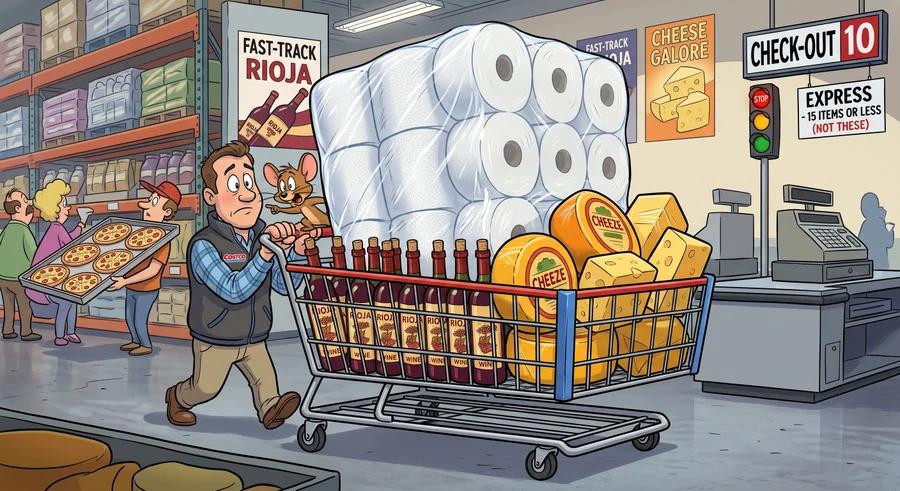
A warehouse trolley containing twelve bottles of Rioja, a slab of kitchen roll large enough to re-roof a bungalow and several kilos of cheese feels like sound financial planning. Everything is cheaper by the case. You will not run out. The price labels use the sort of large numerals that discourage further investigation.
Six months later, you are still drinking the Rioja. It is perfectly decent. You simply cannot remember the last time you bought anything you had not already tried.
This is the danger of wholesale wine buying. Membership can give the average UK household a dependable, cost-effective base layer of wine. It can also turn the contents of the rack into a uniform. The answer is not to reject bulk buying, but to decide which wines should be bought efficiently and which should be allowed to lead you somewhere new.
Think of the sensible bottles as the canvas. Then paint extravagantly on top.
Is warehouse wine actually cheaper?
Warehouse wine is cheaper only when the saving exceeds the membership fee, travel cost and value of anything you would not otherwise have bought.
Costco is the obvious UK example. Its Gold Star membership currently costs £42 a year and is restricted to qualifying employment groups, professions and approved companies. Business membership costs £30 a year, while Executive Gold Star membership costs £84 and offers a 2% reward on most qualifying purchases.
The calculation is gloriously unromantic:
Annual membership cost ÷ genuine saving per bottle = bottles required to break even
If a membership saves you £2 a bottle and wine alone must justify the £42 fee, you need to buy 21 bottles before saving a penny. At £1 a bottle, it takes 42.
If cheaper fuel, food, tyres and household goods already cover the membership fee, the wine does not have to carry the whole burden. That makes the calculation far more attractive. If you join specifically to buy wine, however, the bottles must do the work.
Compare the warehouse price with the price you would genuinely pay elsewhere, not an ambitious recommended retail price that no sober merchant has charged since February.
Does buying wine by the case dull your imagination?
Bulk buying dulls your wine-buying imagination only when convenience begins making every decision.
The first case is reassuring. The second establishes a habit. By the fourth, you have become the household that serves the same Sauvignon Blanc at every barbecue, birthday and Tuesday involving chicken.
There is nothing wrong with a reliable house wine. Most people need bottles they can open without research, ceremony or a small discussion about volcanic soils. The problem begins when every wine has been selected for repeatability.
Wine remains interesting because places, grapes and producers differ. If every purchase is optimised around price, familiarity and volume, you may save 12% while slowly removing the reason you liked wine in the first place.
Which wines belong in the base layer?
Your base layer should contain dependable wines for predictable jobs.
Good candidates include:
A fresh house white for cooking, fish, salads and unplanned visitors
A medium-bodied red that works with pasta, sausages and Sunday leftovers
A sparkling wine for birthdays, drinks before dinner and the discovery that it is Friday
A boxed wine if you regularly want one glass rather than a whole bottle
Two or three bottles you are happy to take to a barbecue without demanding that everybody stop talking during the first sip
These are the wines to compare aggressively on price. Warehouse ranges, supermarket own labels and permanent mixed-case discounts can all work well here.
Majestic, for example, offers its lower Mix Any Six price whenever six qualifying bottles are bought, whether mixed or identical. That gives shoppers breadth without requiring six bottles of the same wine.
Own-label wine is also worth taking seriously. The retailer avoids some of the brand-building expense, and the bottle may offer better value than a heavily marketed neighbour. Judge the producer, region, grape and contents rather than assuming that an ornate château sketch represents extra investment in the liquid.
How much should you reserve for more interesting wine?
A useful starting point is the 70:30 wine rule.
Spend roughly 70% of your wine budget on the base layer and keep 30% for exploration. The exact split matters less than protecting the adventurous portion before convenience consumes it.
Use that 30% for:
A grape you have never tried
A lesser-known region from Portugal, Greece, Georgia, Romania or Croatia
A recommendation from an independent merchant
A better bottle for a particular meal
A skin-contact white, chilled red or traditional-method sparkling wine
A producer whose story, farming or winemaking genuinely interests you
This is where you should resist buying six merely because six is cheaper. One bottle of something unfamiliar teaches you more than a discounted case of something you already understand.
The important trick is to make the saving visible. If bulk buying saves £18 on your household case, move that £18 into a separate wine-exploration pot. Otherwise, the saving disappears into the general financial fog and eventually becomes washing-up liquid.
Which cheaper wines offer the best value?
Value often appears one step away from the famous name.
If you like Champagne, try traditional-method sparkling wine from Cava, Crémant, England or South Africa. If Barolo is beyond the evening’s budget, look for Nebbiolo from Langhe. Fans of white Burgundy can explore Chardonnay from the Mâconnais, Limoux, South Africa or cooler parts of Chile.
Other useful sideways moves include:
Northern Rhône Syrah to Syrah from Crozes-Hermitage, Saint-Joseph alternatives, South Africa or cooler Australian regions
Châteauneuf-du-Pape to Grenache-led reds from the southern Rhône, Languedoc, Roussillon or Spain
Sancerre to Sauvignon Blanc from Touraine, Menetou-Salon, South Africa or Chile
Red Burgundy to Gamay from Beaujolais or elegant Cabernet Franc from the Loire
Provence rosé to dry rosé from Languedoc, Navarra or Portugal
The point is not to find an imitation. It is to identify what you actually enjoy, such as acidity, perfume, tannin or weight, and buy those qualities without paying entirely for the postcode.
Classification can help, but higher classification does not guarantee greater pleasure. An IGP wine made with freedom and care may be more interesting than a joyless bottle carrying an impressive acronym. Wine law is useful evidence, not divine judgement.
Are supermarket multi-buy offers genuine bargains?
A percentage discount is useful only if the final bottle price is competitive.
Tesco, Sainsbury’s and Waitrose have all recently run 25% discounts on six qualifying bottles, sometimes allowing the discount to work alongside existing loyalty prices. The exclusions, minimum bottle prices and regional availability differ, particularly in Scotland and Wales, so the checkout total matters more than the headline.
Use this four-point check:
Write down the final price per bottle.
Compare it with two other retailers.
Buy only wines you already wanted or deliberately chose to explore.
Check whether the promotion excludes boxed wine, fortified wine, small bottles or existing multi-buy offers.
A £10 bottle reduced to £7.50 may be excellent. A bottle raised to £10 so that it can spend its life ‘reduced’ to £7.50 is merely wearing a promotional hat.
Loyalty prices deserve the same suspicion. Compare final prices, not the emotional excitement generated by yellow cardboard.
Are Christmas wine deals worth waiting for?
Christmas wine deals can make festive bulk buying worthwhile, but only if you plan the case before the promotion appears.
Start with the occasions, not the offers:
Christmas lunch
Drinks before lunch
Boxing Day leftovers
A party or large gathering
Host gifts
Quiet bottles for the period after everybody has gone home
Decide the quantities and styles first. Then wait for the supermarket Christmas wine deals, mixed-case discounts or warehouse offers that fit the plan. Do not allow a 25% promotion to persuade you that December requires eighteen bottles of Prosecco and no red wine.
Buy the dependable festive base layer in bulk. Spend separately on the bottle that will matter with lunch, the mature Port for cheese or the Champagne you actually want to drink. Nobody remembers that the background Sauvignon Blanc cost £1.70 less. They may remember the glorious bottle opened with the roast.
Boxed wine can also be useful over Christmas. The bag limits contact with oxygen, so the wine remains drinkable for longer after opening. It is well suited to a busy house where people want different amounts at different times, although a low price per litre is not compensation for wine nobody enjoys.
What should you do before buying another case?
Audit your last twelve bottles before purchasing the next twelve.
For each bottle, record:
What you paid
Where you bought it
Whether you would buy it again
Whether it was everyday, exploratory or celebratory
What you liked about it
Then choose three dependable base-layer wines and compare their real per-bottle prices at your supermarket, wholesale club and preferred wine merchant.
If a membership produces a genuine annual saving after its fee, keep it. If it merely encourages larger transactions, more repetition and industrial quantities of snacks, cancel it without sentiment.
Finally, protect 30% of the budget for curiosity.
The ideal wine rack is not a shrine to thrift or a collection of expensive talking points. It contains bottles that do their jobs efficiently, leaving enough money and appetite for the ones that might surprise you.